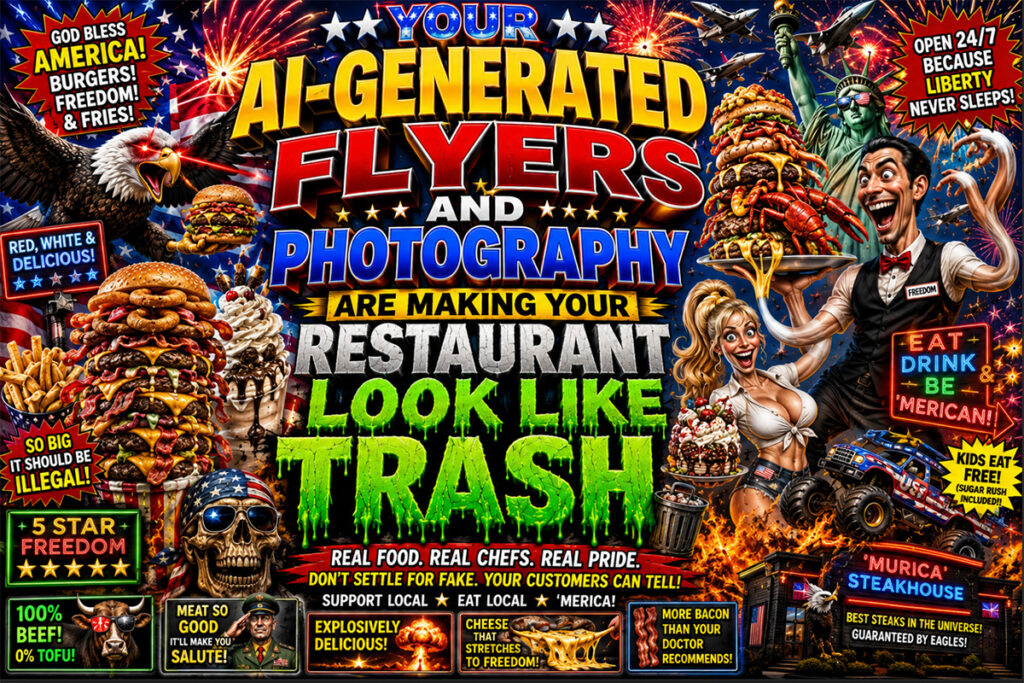
As anyone with even the slightest connection to the restaurant business knows, keeping your business afloat, let alone thriving, can be physically and mentally exhausting. After all, as an owner/operator or chef, you’re actually keeping a lot of balls in the air at any given time; you’re likely also the accountant, the maintenance guy, the refrigerator repairman, the plumber, the HR department, the staff therapist, and yes, the social media and marketing director. When you are feeling stretched thin, the cheap, readily-available rise of generative A.I. can feel like a gift; an easy shortcut you can take to knock just a few items off your never-ending to-do list, with results that are more polished than anything you could produce on your own.
The problem is that the time saved by using these tools to promote your business costs you immeasurable amounts of credibility.
Restaurants Run on Trust
One of the most fundamental parts of the covenant you enter with your current (and potential) customers is built entirely upon trust. It’s what the very act of “going out to eat” actually is. As a customer, you are implicitly saying, “Someone out there can cook with more skill or creativity than I am capable of at home right now. I trust them to bring new flavors, combinations, and technique to my table, even if it is unfamiliar or feels risky.” It’s a part of the whole relationship between customer and chef that I take very seriously, and it’s an unspoken bond that I absolutely cherish.
When a customer chooses your restaurant from among the hundreds (thousands! millions!) of other options available to them, they can’t make that choice based on the things they can’t see. They don’t know about your training, your years of experience, where you’re sourcing your ingredients, how clean you’re keeping the stainless steel backsplash behind the line, or how well you treat your staff. Instead, they’re choosing your restaurant out of all of the rest because of the things they CAN see. Things like your website. Your online reviews. Your dining room’s “vibe.” Your social media feed. And especially your marketing materials, both online and off.
In this environment, the photos you post of your food, and the artwork you use to promote special events or menu specials all become huge signal flares to your potential guests, who may not have insight into the internal mechanics of your business.
What Customers See When You Post an A.I.-Generated Flyer or Advertisement
It can be easy to convince yourself that customers won’t notice an A.I. shortcut, or that they won’t care as long as the food is good and the vibe is right. But those customers are becoming savvier and sharper about identifying computer-hallucinated nonsense, whether it’s a too-perfect photo of your food or a flyer promoting your latest event or special. They’re paying closer attention than you’d think, and even if they can’t quite tell if something has been generated by a prompt, they know when something feels off or makes them uncomfortable, which most A.I.-generated art and photography definitely does. There’s something about these images that feels generic and soulless, and customers are tuned into that, even if they’re not sure exactly why. Instead of feeling drawn to your special, your audience is often left with a vague feeling of mistrust; not the ideal first impression to make on a new customer.
The Steak Test
For as vile as I find A.I. generated artwork used to promote a special event or weekly special, I think the problem gets even worse when A.I. is used to “enhance” a restaurant’s photography, or even worse, generate it completely from scratch. Again, I understand the temptation: Styling, plating, and then capably photographing food can be a challenge, especially for a harried chef with a million other things to do. And after all, a steak is a steak, right? Surely the ones you’re producing in your kitchen looks just like the ones generated by an A.I. prompt? And who would ever know the difference?
Let’s take the steak example a step further. If your restaurant is known for its steak, it’s probably because you’re taking great care in where you source your beef, and the technique you use to cook it. You’re buying from a local farm, maybe, or selling only grass-fed beef, or slaughtering cows that have been given warm sake massages for their whole lives. The point is, you wouldn’t suddenly start serving your customers, I dunno, lab vat-grown beef-flavored rat cell clusters, or some other kind of “fake” meat, and hope that nobody notices, right?
When you post an A.I.-generated photo of a fake steak as a means of promoting your business, though, that’s exactly what you’re doing. You’re training customers to expect something you can’t deliver, because it’s food that has never existed in real life. This isn’t an issue about technology…it’s one of authenticity.
Like it or Not, Food Photography is Part of This Now
No matter how much you may hate it, or think it’s not fair, or think it’s something you shouldn’t have to make time for, advertising your restaurant has become an extremely visual exercise. Some chefs care about it, and some just want to be left alone to cook. Some hire dedicated “social media professionals” to follow them around and bother their staff and come up with a never ending stream of dopey ideas to feed the never-ending content monster. And some turn to generative A.I. as a shortcut to developing skills as a capable food photographer, in an effort to save time and money.
That last option is the worst.
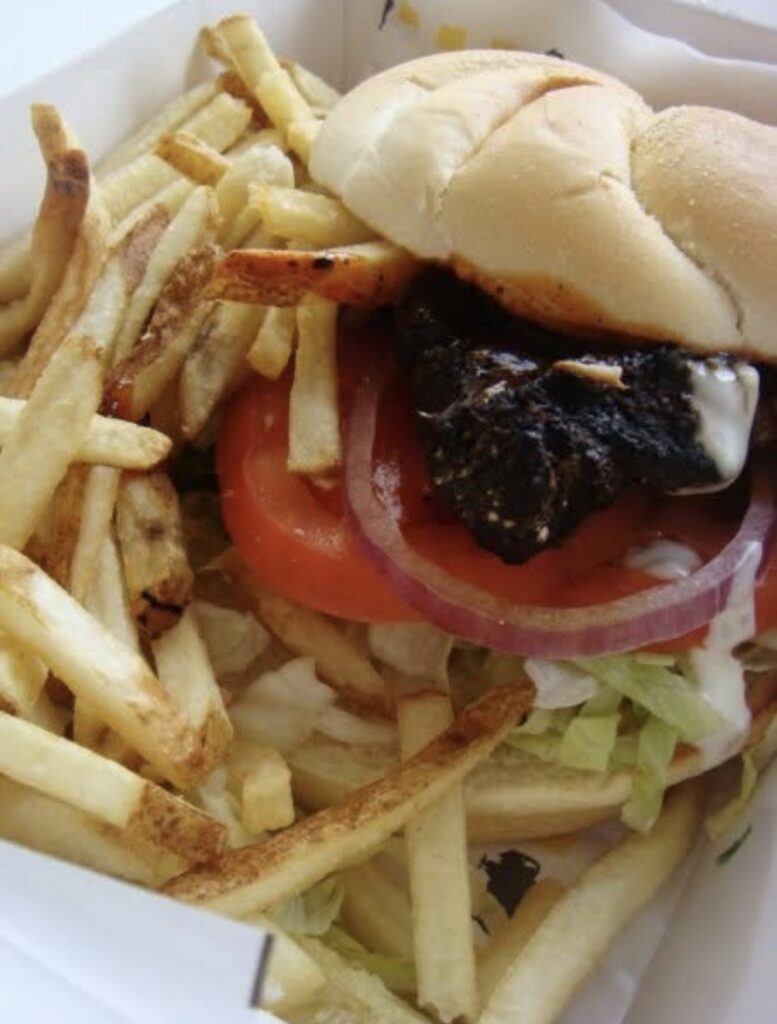
For better or for worse, being able to take an attractive photo of the food you create is a requirement that’s here to stay. But I think some chefs and owners think of it as an unattainable skill best left to professional photographers or social media wangs. Just like any other skill, though, learning the fundamentals is a process, just like, say, learning to bake bread, or craft a compelling menu description, or learning to cut big things into really small things without lopping off a finger.
Mostly, getting better at food photography is just about doing it, and not being too hard on yourself about the early results. You don’t need to take up a whole new hobby, and you don’t need to know your aperture from your f-stop. Learning to use natural light, plate dishes in a way that is attractive to the camera instead of the eye, and use basic photo editing tools to bump up brightness and saturation is a skill that can and should be honed; even a throwaway photo on a social media post is another way of presenting your work, and showing your actual food to a potential (or regular customer is something to feel proud of. Typing a list of your ingredients into a prompt and letting a computer sort out its interpretation of your cooking is not.
The Weird Message Your A.I. Flyer is Sending
Similarly, an A.I.-generated flyer advertising a weekly special or a live music act that may be aesthetically pleasing is simultaneously sending a very different message: That you, the owner, manager, or chef, simply don’t care and can’t be bothered. Whether that’s fair or not, the dining public can only see so many of these:
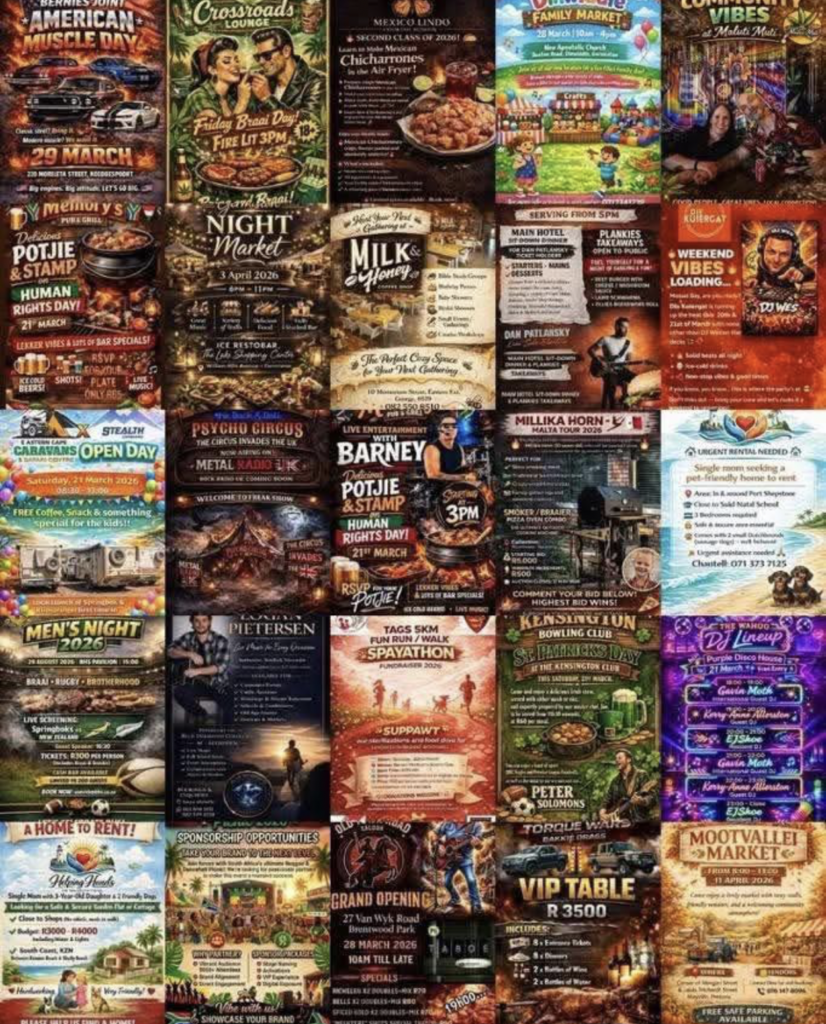
…before they all bleed together and look the same. Sure, they may look more professional than similar graphics that you’ve dreamt up in Canva or using a pen and paper, but they say absolutely nothing about the character of the business or the people running it, other than, “This restaurant is aware that ChatGPT exists.”
A flyer that you design yourself, or that your sister’s kid who’s in his first year at RISD creates, or that you paid someone $10 to create on Fiverr, still says SOMETHING. It says “somebody made this.” Most often, an A.I. flyer screams “nobody made this,” and that’s not an association you want for your business.
By all means, if you can hire a local illustrator, photographer, or copywriter, I think you should. Realistically, that’s not in the budget for most restaurants, and I tend to push back at the argument that A.I. is taking jobs away from local artists. Chances are, the restaurant that’s using A.I. image creation tools, probably wasn’t ever going to hire someone local, anyway.
But even if you can’t support local artists (who, by the way, are part of the same financial ecosystem that keeps your restaurant busy), that’s understandable. Your own efforts as a designer, or a handwritten note, or a crooked chalkboard, or a grinning server, or a stained recipe, or a bad iPhone photo, all at least create a human connection with the viewer, which A.I. can never do. Customers respond to humanity and effort. Put some in. Real beats perfect, every single time.
Here’s the bizarre contradiction: As restaurant owners and chefs, we bend over backwards to tell our customers all about our locally sourced ingredients, or our scratch-made artisanal processes, or how well we know the guy who killed the pig that gave up his chops for our menus, or how much care and attention our Sous puts into plating because he was raised an orphan and had to learn food styling on the streets. All of these things are an effort to drive home that we are special, we are small-batch, we are curated, we are crafted, we are human…and then we use a machine trained on billions of other images to produce generic marketing? We use our food and our menu copy to say “we care deeply,” and then our marketing to say, “Eh, whatever?” That just doesn’t make sense.
Customers Demand a Human Touch, Not Perfection
Here’s what I’m hoping you’ll think about. A customer doesn’t care if you’re producing studio-level photography or glossy, loud flyers promoting your latest event. They care whether your corned beef hash is homemade. Or whether your burgers are cooked nicely. They’re looking for any evidence that another human that they can trust made the food that they’re considering venturing out of the house for.
Cooking for a living is one of the last truly human professions, in a world rapidly being swamped by artificial intelligence, and the trust between cook and customer is paramount to the entire experience. It’s what makes the whole relationship so special in the first place. Every screeching A.I. flyer, every uncanny valley-looking line cook with his thumbs on backwards, and each burger that stands three feet tall in an impossible orgy of perfectly melted cheese and sauce dripping upside-down only serves to undermine that trust.
You started cooking because you had something you wanted to show the world. Show them.

Malcolm is the co-author of “Eating in Maine: At Home, On the Town, and On the Road,” and chef/owner of Honey’s Fried Chicken Palace in Thomaston. He lives in Midcoast Maine and has spent the better part of two decades chasing good meals and even better stories.